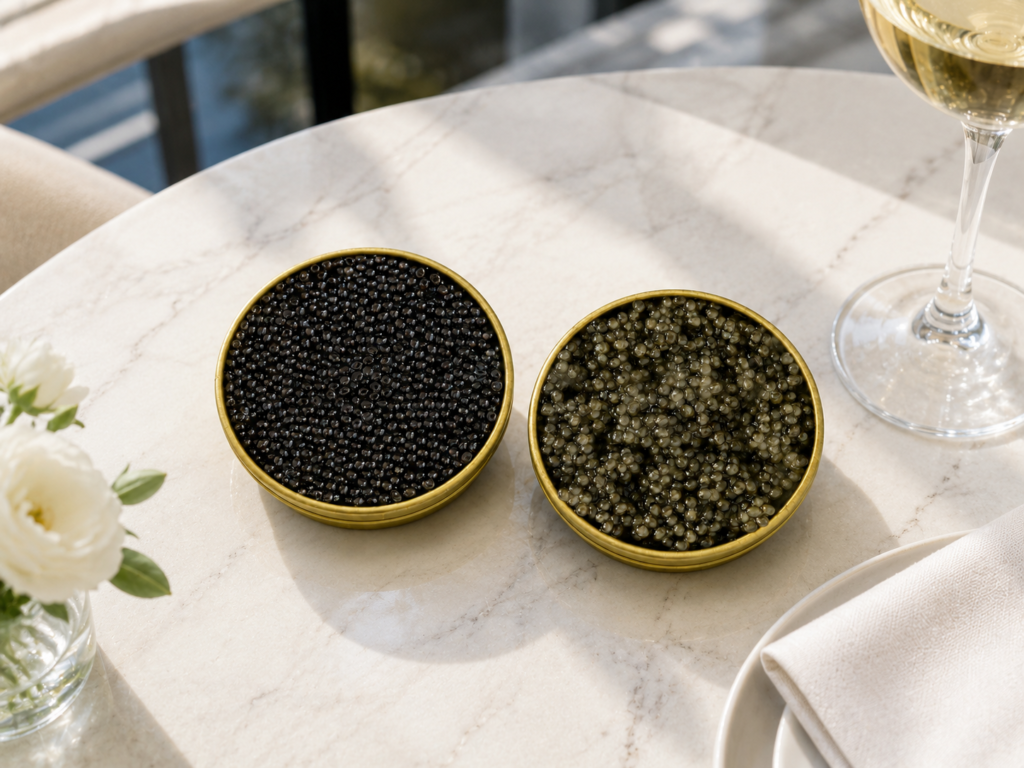


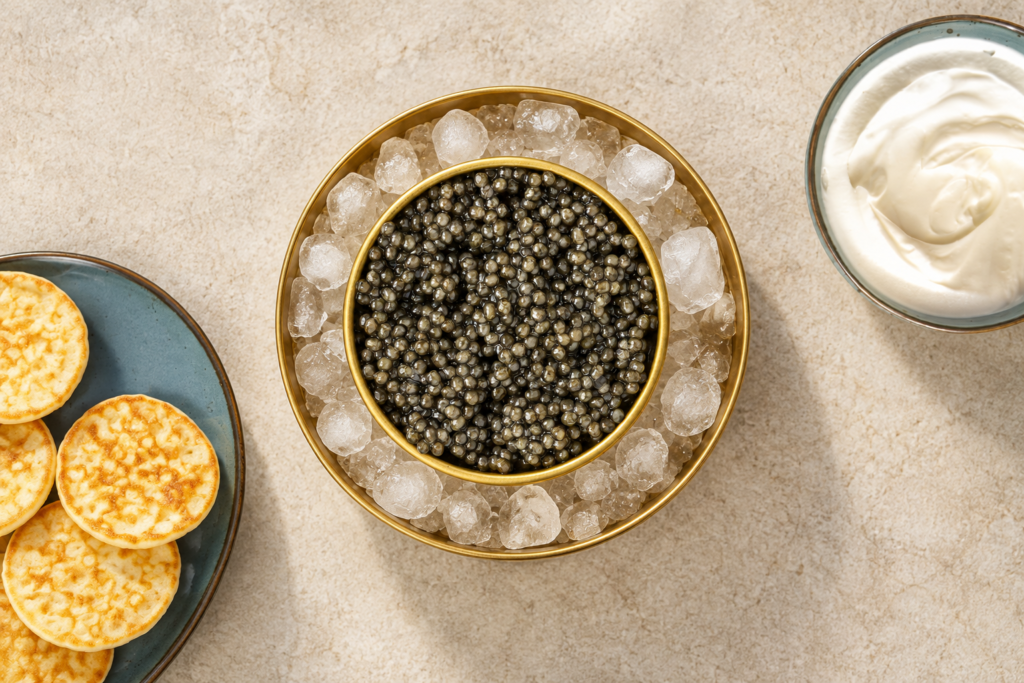
The short answer is: Black caviar should be stored in the fridge, at a temperature of −2 °C, in the coldest part, and should be eaten within 2 or 3 days of opening the tin. So far, so easy. The rest comes down to the details, which determine whether you’ll experience the caviar as it was when it left the production line, or merely a pale imitation of it.
You’re buying something that has been carefully looked after every step of the way to you. A cold chain, a certificate, a courier with an insulated box. And then the box ends up in the fridge door, next to the ketchup, because that’s where there’s space. This is the most common way for good caviar to go off at home, and it has nothing to do with the quality of the product.
Storage isn’t just a technical detail. It’s the final stage of production – only it takes place in your kitchen.
Should black caviar be kept in the fridge?
Yes, always. Black caviar is a fresh, lightly salted product of animal origin and does not keep well at room temperature. The salt it contains is sufficient to bring out the flavour and extend its shelf life by a few days, but not enough to preserve it permanently, as is the case with heavily salted fish.
That is precisely why caviar is transported under refrigeration and must be placed in the fridge as soon as it reaches you. Every hour it spends on the worktop reduces its freshness and brings the moment closer when the pearls begin to soften.
What is the correct storage temperature for black caviar?
−2 °C. This temperature ensures that the pearls remain firm and the flavour remains pure.
The problem is that most domestic fridges are not as cold as their owners assume. The average temperature inside a domestic fridge is often around +6 or +7 °C, whilst it can reach as high as +10 °C on the door. The US Food and Drug Administration recommends using a separate thermometer precisely because the built-in indicator rarely tells the truth.
If you intend to buy caviar regularly, a fridge thermometer is the cheapest investment you’ll make for it. Leave it on the shelf you intend to use for a day and see what it reads in the morning, before you open the first jar. The result surprises most people.
There is also one detail that explains why professionals stick to the lower limit. Lightly salted caviar freezes below zero, but not exactly at zero: the salt lowers the freezing point by about one degree. That is why a tin left resting against the back wall of a fridge set to a very low temperature may develop a layer of ice, even if you haven’t changed any of the settings. You want it to be cold, but not in direct contact with the coldest part.
Where exactly in the fridge should the caviar be kept?
In the coldest part – though it’s almost never where people put the caviar.
- Best of all: the bottom shelf, closest to the back wall, or the drawer for fresh fish and meat, if the fridge has one.
- Acceptable: middle shelf, right at the back, far from the door.
- Never: the fridge door. It is the warmest area, and the temperature inside it rises every time it is opened.
- Never: the freezer compartment or directly next to the evaporator, where the box may freeze.
Stability is more important than the exact temperature. Caviar that is kept at a constant +3 °C is in better condition than caviar that fluctuates between +1 and +8 °C several times a day.
How long does unopened black caviar keep for?
An unopened box has a use-by date printed on it, and that is the only one that applies. Do not work it out in your head or extend it based on a hunch.
This expiry date is only valid if the box has been kept within the correct temperature range at all times. A single day in the heat can render weeks of that period invalid. If you have received a parcel and are unsure how long it has been in transit without refrigeration, it is wiser to trust your senses rather than the date.
Please also note the difference between two labels that look the same but are not. „Best before“ refers to quality: after this date, the product is probably still safe to eat, but it is no longer what it used to be. „Use by“ refers to safety and is not open to interpretation. With fresh, lightly salted caviar, it is the second label that matters.
How long does black caviar keep once opened?
2 to 3 days, tightly sealed, in the coldest part of the fridge. This is the ideal place for opened caviar to stay just as it should be.
You’ll come across claims online about how long it lasts. Don’t believe them. The moment the tin is opened, it comes into contact with the air and everything it carries. The flavour changes, first imperceptibly, then noticeably: the saltiness comes to the fore, the purity is lost, and the pearls soften.
There is also a second reason that is rarely mentioned. Every time you open the box again, the process starts all over. Opening it three times in smaller amounts over three days is worse for the product than opening it once and enjoying it all in one go. If you know in advance that you won’t finish the whole tin in one go, it’s better to buy a smaller size rather than stretching out the larger one.
The practical conclusion is simple and rather liberating. Only open a jar of caviar when you’re going to eat it. It’s just like champagne: you open it and drink it.
Can black caviar be frozen?
No. Freezing is the only thing that can ruin good caviar irreversibly in one go.
The reason is physical. Every pearl is a shell filled with liquid. When frozen, this liquid expands and tears the shell from the inside. A defrosted pearl is no longer a pearl: it bursts at the slightest touch, releases a cloudy liquid, and the texture you paid for disappears. The taste changes too – and not for the better.
You may sometimes read that, at very low temperatures and using the „right technique“, freezing is possible. In industrial settings, with certain products and using equipment that no kitchen possesses, such things are done. A domestic freezer is not that sort of equipment. It freezes slowly, and slow freezing forms large ice crystals: it is precisely these that tear the pearl’s shell.
If you’ve bought more than you’re going to eat, the answer isn’t the freezer. The answer is to invite someone round.
Should the caviar be kept in its original box?
Yes. The original box is designed precisely for this purpose: it is opaque, airtight and sized to leave a minimal amount of air above the product.
Transferring the contents to another container almost always makes matters worse. More air, more surface area, and the risk of foreign odours. What’s more, you lose the label, and with it the batch number and certification code, which are the only proof of exactly what’s inside.
If the box has an elastic band or tape around the edge, put it back in place after opening. It is not a decoration.
The only situation in which transferring the caviar is justified is if the original packaging is damaged: a warped rim that prevents it from closing tightly, or a lid that no longer fits. In that case, choose the smallest glass container that will hold the caviar almost to the top, seal it tightly and eat it the same day. Glass is neutral and does not react with the product.
How should leftover caviar be stored in an open tin?
There is just one aim: to have as little air as possible above the pearls.
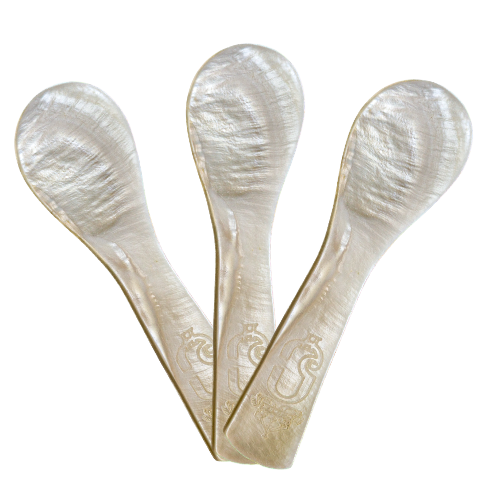
- Carefully level the surface with mother-of-pearl spoon, without pressing down.
- Close the lid tightly and press it down gently to ensure it seals properly.
- If the tin is still half-empty, cover the surface with a small piece of cling film, placing it directly on top of the caviar, before putting the lid on.
- Put the box back on the coldest shelf straight away, rather than after you’ve cleared the table.
- Keep it away from onions, citrus fruits, cheese and anything with a distinctive smell. Caviar absorbs foreign odours surprisingly quickly.
How can we tell when black caviar is no longer fit for consumption?
Your instincts will tell you before the date. Look out for these signs:
- Aroma: Fresh caviar has a subtle, clean, sea-like scent. Any sharp, sour or ammonia-like note means it’s gone off.
- The Pearls: They must be separate and firm. If they have stuck together to form a uniform mass or are cracking on their own, the product is past its best.
- Liquid: A small amount of natural oil is normal. A cloudy, copious amount of liquid at the bottom is not.
- The cover: A bulging lid or gas escaping when you open it is a reason to throw the tin away without even trying it.
- Flavour: If the first bite is bitter or too pungent, stop. High-quality caviar never needs to be „worked through“.
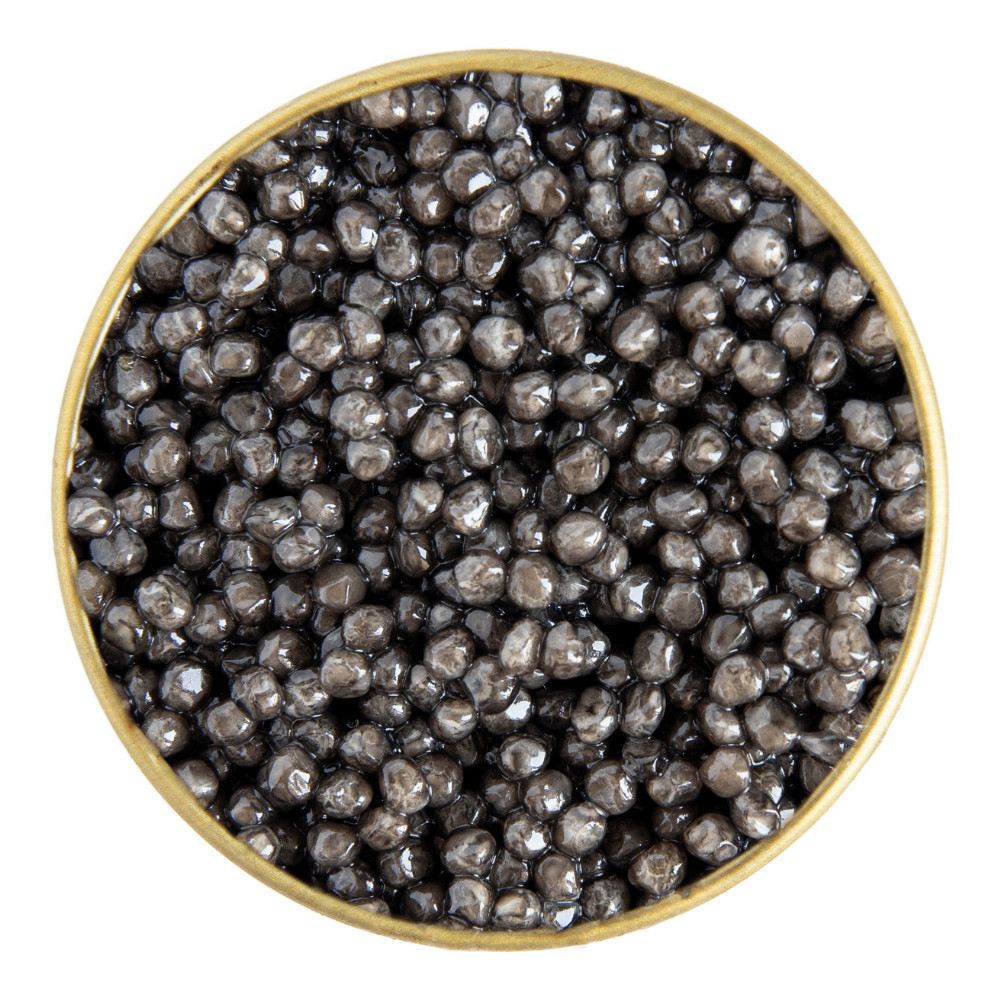
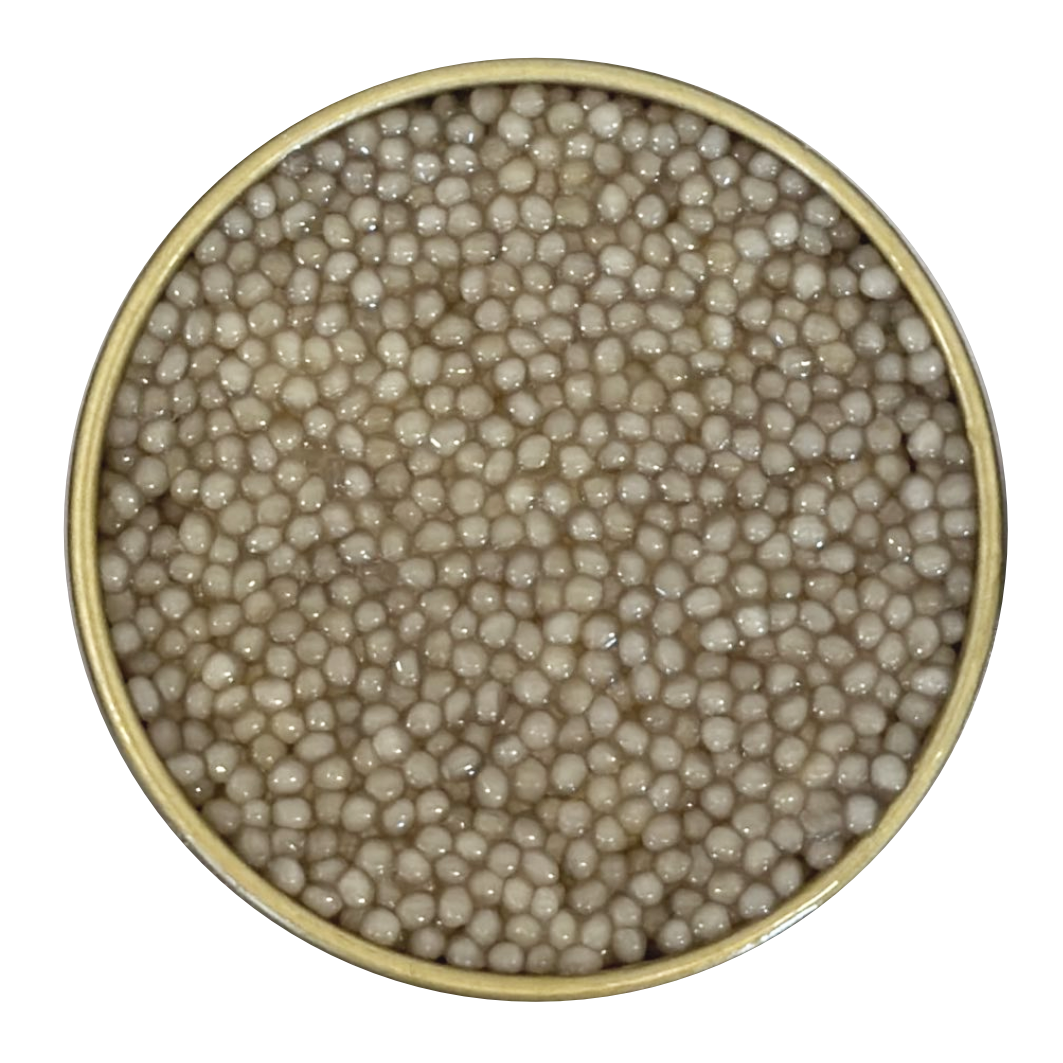
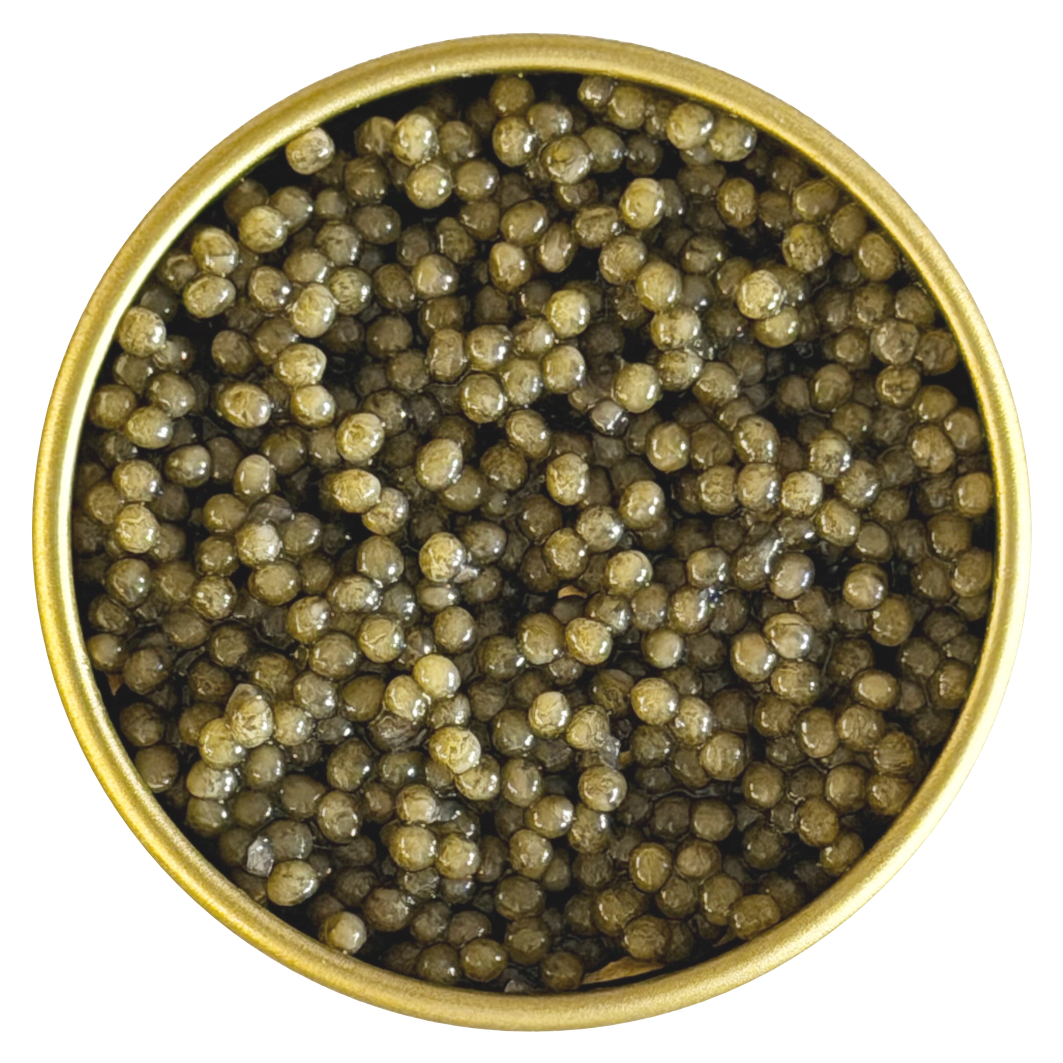
Two points to bear in mind, so you don’t throw away something that’s perfectly fine. A thin layer of clear oil on the surface is normal and even desirable: this is the caviar’s own fat. And the colour alone is not a sign of spoilage. The roe varies in colour from light grey through olive to almost black depending on the variety and batch, and a tin that is darker than the previous one is nothing to worry about.
If in doubt, throw it away. Black caviar is expensive, but not as expensive as food poisoning.
How do we get the caviar from the shop or the courier to the fridge?
The time between the shop display and your fridge is the most vulnerable part of the product’s entire journey.
When buying in-store, ask for a cool bag and pack the caviar last, just before you set off. Do not leave it in the boot of your car in a car park during the summer, not even for twenty minutes. If it’s delivered, open the parcel straight away, check that the ice pack is still cold, and put the box away before reading the accompanying documents. They’ll wait for you, but the caviar won’t.
Our terms of delivery They describe how the parcel is delivered to your door. From there on, it’s up to you, and that’s the only part over which we have no control.
When should we take the caviar out of the fridge before serving?
Just before serving. Not five minutes earlier, not „to relax“.
This tip is doing the rounds on cooking websites, but it’s wrong. Caviar isn’t cheese and doesn’t need to be brought to room temperature. Heat does not bring out its flavour, but rather washes it away: the saltiness comes to the fore, the purity fades, and the pearls lose their firmness precisely at the moment when they should be at their best.
The correct procedure is to take the box out of the fridge and immediately place it on a bed of crushed ice. The ice takes care of the cooling, whilst you take care of the celebrations. The detailed procedure is described in our article on this subject How to serve caviar properly.
Set out everything else in advance: the plates, the spoons, wine, pancakes. The caviar is served last, when the guests are already seated around the table. This is the only sequence in which the first bite is exactly as it should be.
Do different types of black caviar require different storage conditions?
The rules are the same across the whole a selection of black caviar: −2 °C, 2 to 3 days after opening.
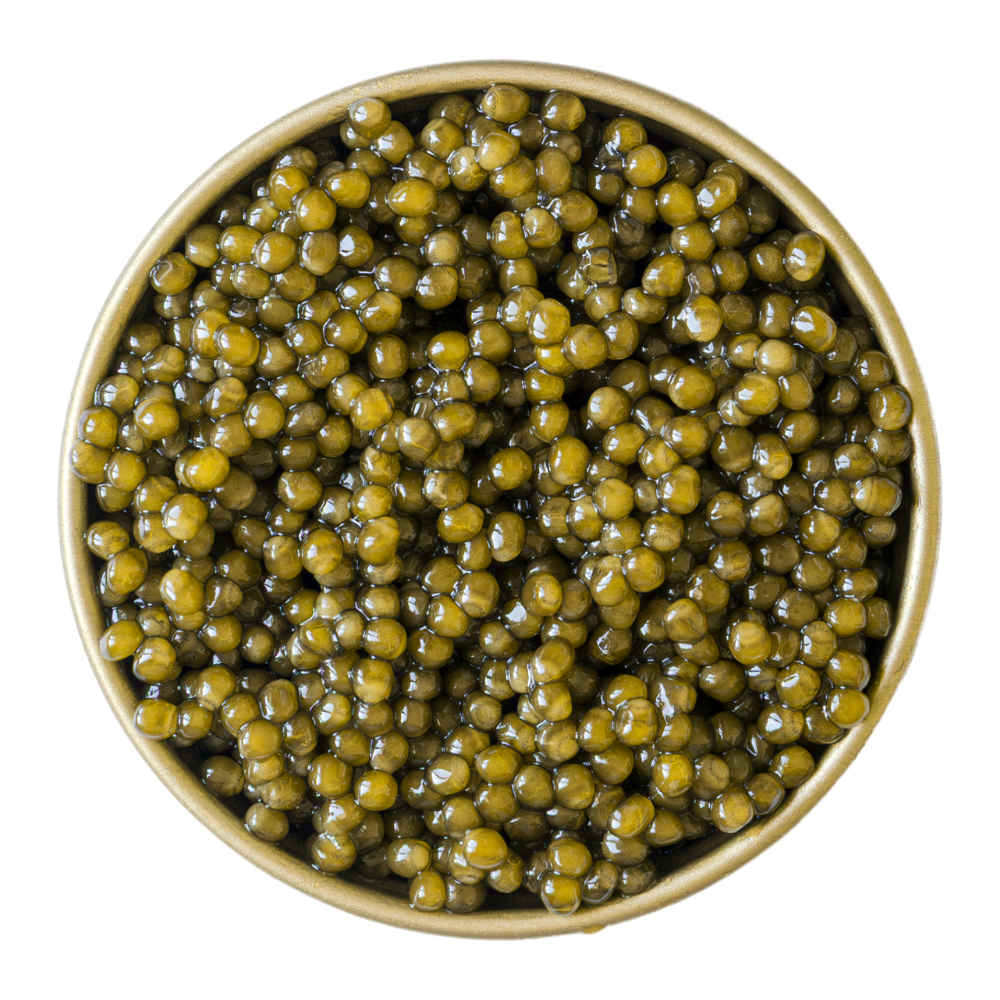
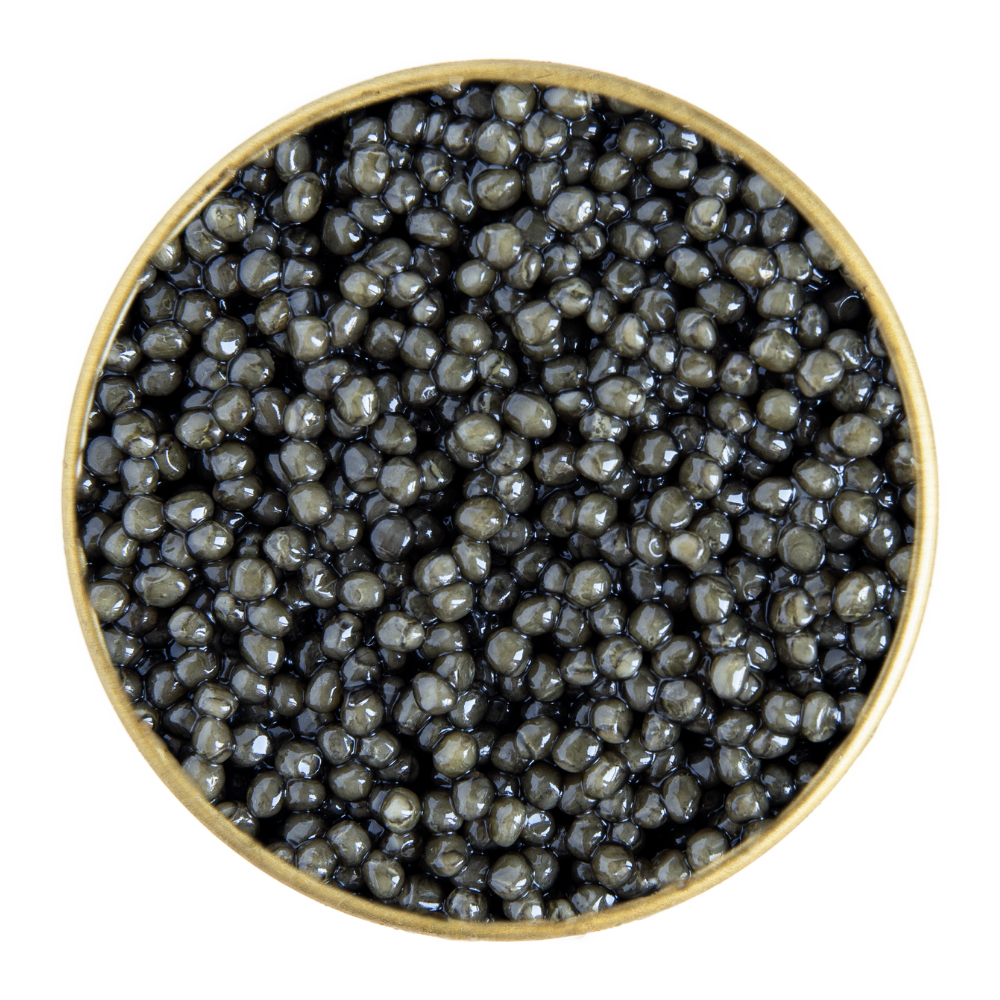
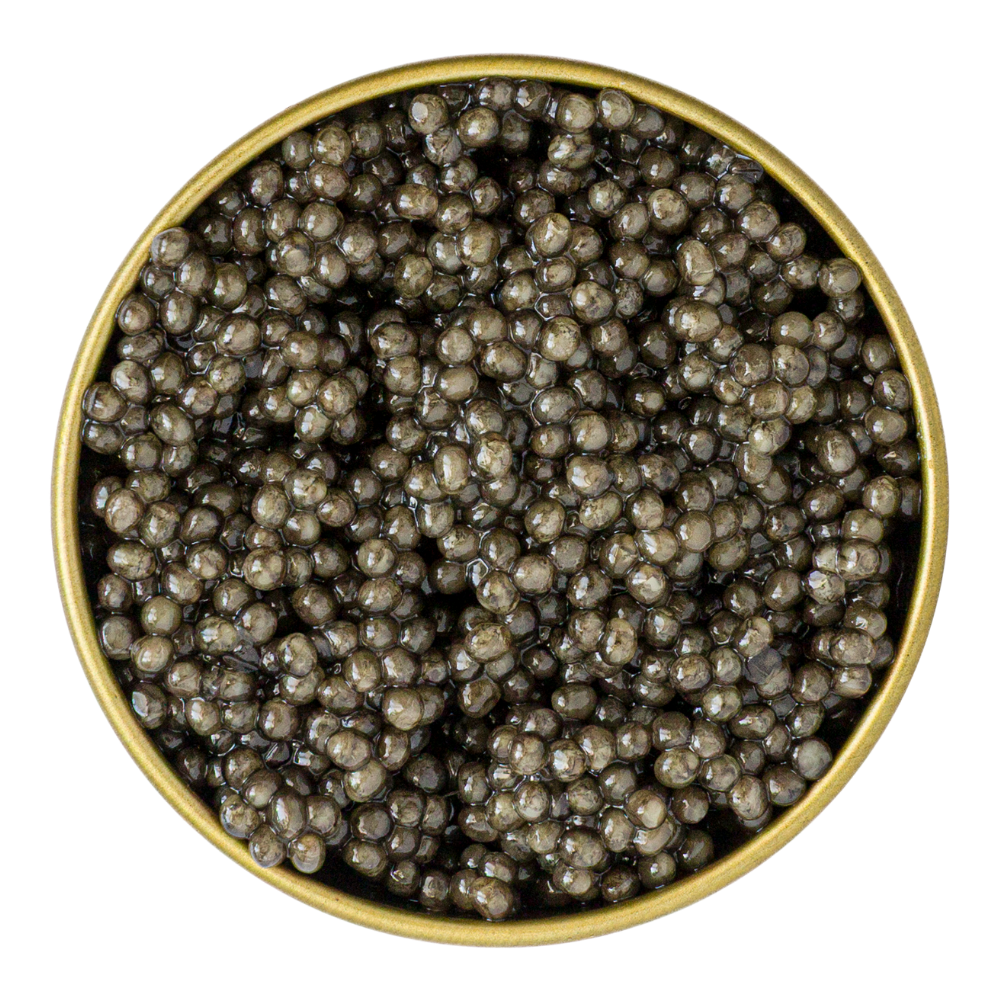
The difference lies in how clearly you will notice the fault. The more delicate profiles reveal it first. The soft, oily character of Baerii Gold Æmillius Caviar begins to disintegrate earlier than the dense structure of the large pearls of the beluga. The scent of the fresh sea, which sets it apart Russian sturgeon, is the first thing to go if it is stored incorrectly.
In other words: the finer the caviar, the less forgiving it is.
One exception for the sake of convenience. The caviar is crackling, which is used as a topping, is more resistant to handling than traditional varieties because its structure is fundamentally different. The temperature guidelines, however, remain the same. Texture stability is not the same as heat stability.
What are the most common mistakes people make when storing black caviar at home?
- The fridge door. The most common and most costly mistake.
- The freezer. It irreversibly destroys the texture.
- Opening „just to have a look“. Every time it is opened, the clock runs for 2 to 3 days.
- Transfer to a bowl to keep for later. The bowl won’t close.
- Take it out half an hour beforehand. The opposite of what is needed.
- Placed next to aromatic foods. Caviar absorbs odours.
- Trust the date rather than your nose. This date is valid only if the cold chain is maintained.
What should we bear in mind when storing black caviar?
Three figures and one habit. −2 °C. The coldest shelf, never the door. 2 to 3 days after opening. And the habit of only opening the tin when there’s someone to eat it.
Notice how little effort this requires. There’s no special technique, no equipment you need to buy, no ritual to learn. There’s one shelf that’s the right one, and one moment that’s the right one. Everything else in this article explains why.
The rest is a matter of aftercare, which the product fully covers. If you have a question that this article doesn’t cover, please see the detailed storage and serving instructions or us ask the question directly. Our experts are also available on Sundays.
And if the box’s been open since yesterday and you’re wondering what to do with it: invite someone round today. That’s the only storage problem that has a pleasant solution.
Sources
- U.S. Food and Drug Administration – Fridge Thermometers: Cold Facts about Food Safety
- U.S. Food and Drug Administration – Choosing and Serving Fresh and Frozen Seafood Safely
- European Food Safety Authority – Listeria
- World Health Organisation – Food safety
- Æmillius Caviar – flavour profile of black caviar